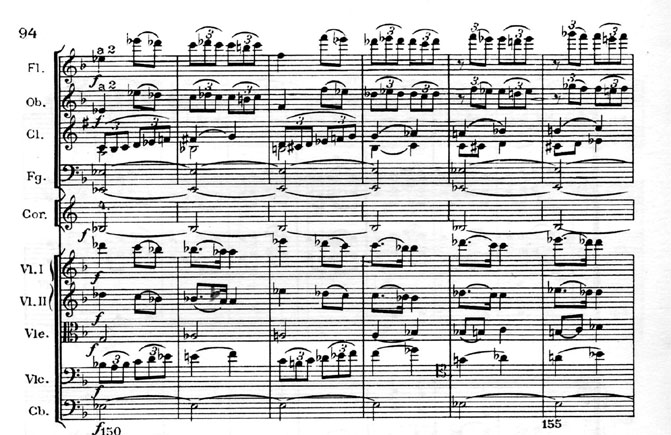
Scoring for
Woodwind
By Terry Dwyer
1) Wonderful
Woodwind
For me, the woodwind section is
the most interesting part of the orchestra. When I was having an
organ lesson in my youth, my teacher finished a piece on a loud
sustained chord and said proudly 'Listen to that, Terry!' That chord has the same
tone colour from top to bottom. You can't do that with an orchestra!' I
was not experienced enough then to refute that claim as I would now:
'And a good thing too: the different ways an orchestra could score that
same chord are far more interesting.'
Leaving aside percussion as being
in a different category, we can see that both the strings and the brass
sections are capable of producing chords which represent a similar
blended sound throughout the section, in spite of minor differences.
With the woodwind this is not so: the four main prototypes differ
enough for it to become a problem making a chord sound blended.
The other side of this coin is that we have a splendid variety of
individual sounds, each able to impart a particular flavour to the
music. Instead of being a family with common traits, the woodwind is
more like a collection of friends with different talents and a common
interest. Part of the orchestrator's art is to exploit those
talents.
[The
Nutcracker Suite
(Casse-Noisette).] If you
possess, or are willing to acquire, the score of Tchaikovsky's miniature
masterpiece, you will find in it many illustrations of the points I will
be making. References below will be headed NS, and the movement
title and bar number given.]
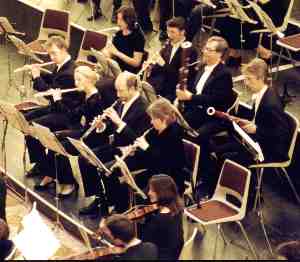
Photo courtesy of Bath
Philharmonia
The Standard Woodwind
Group
All sorts of woodwind groupings are possible, and we
will deal with some later; but it is wise to learn first to master the
standard classical group of eight players: 2 fl, 2 ob, 2 cl, 2 bn, as in
the picture above. Once you are fluent working with this set-up, then
further combinations should not be too difficult. Let's dive
in.
Firstly, we can observe that the
general volume level/range possessed by each of the four instruments is
about equal. In other words they all have a similar chance of being
heard against each other. (Note the popularity of the 'wind quintet',
where the four woodwind stand on equal terms, alongside the admittedly
slightly more powerful horn, who must use discretion.)
Secondly, and most important, we must note that each
of our Big Four does not have a uniform volume range throughout its
compass, and this greatly affects scoring considerations. In more
detail:
1)
The flute is weak at the bottom
of its compass, but gets more and more powerful as it rises to the
top, where it is very penetrating.
2)
The oboe is strong and difficult
to keep down at the bottom of its range, and gets weaker as it rises
to the top of its compass.
3)
The clarinet is fairly even
throughout, but lacks a little power in the middle. Alone of the four,
it has an enormous range of controllable expression, from pppp
to fff.
4)
The bassoon is similar to the
oboe, though not quite as markedly.
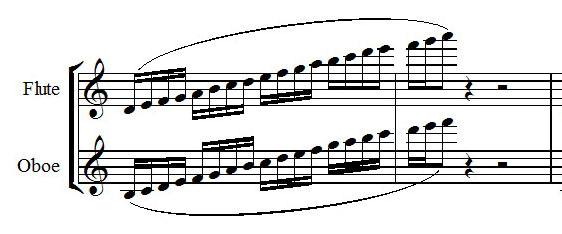
So, in a passage like the
following, the flute would be covered at first, and the oboe would
tend to disappear at the end:
This is true no matter what dynamic
mark is applied to both players. The middle three beats could sound
nicely balanced in practice, but for the first beat the oboe would
predominate, and in the second bar the flute would
predominate.
Example
1
 Listen
NOTE: You will want to be looking at each
music example as you listen to it. If your mp3 player blots out the
screen when you press 'Listen', then try one of the following: a) if
you have twin monitors, move the player to the other monitor; b) if
not, then minimise the player as soon as it
appears
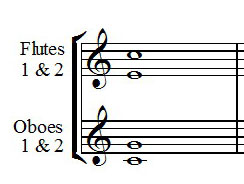
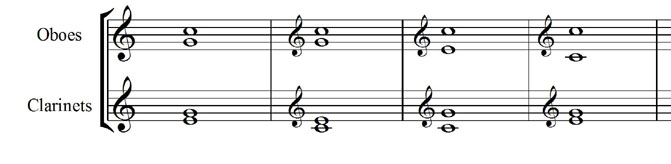
Look at this chord : do you think
it will sound blended?
It
could do, if the players make an effort to listen carefully, but
it is courting trouble, especially with an amateur orchestra. Better to
replace either the flutes or the oboes with clarinets, and the problem
disappears.
This problem would not arise with
the clarinets and bassoons because the bassoons can be controlled easily
except right at the bottom of their register, where clarinets cannot
reach.
However, never forget that even the
best oboists and bassoonists cannot be relied on to produce pp on
their bottom two or three notes. In the Pathetique Symphony,
Tchaikovsky's pppppp for the bassoon on low D carries an
invisible label 'I wish!!!' (And in practice this passage is often
played by the bass clarinet.)
Likewise, the flute (and piccolo)
cannot produce their very top notes very softly; indeed for many players
the top notes B and C cannot be produced at all unless approached with
an upward rushing scale, slurred. Best to treat A6 as the normal
limit.
So much for volume-balancing
problems. But what about blend of tone-colour? Alan Belkin has rightly
suggested that because the tonal quality of each instrument varies as it
rises, it is advantageous to think of each instrument as three
subsidiary instruments according to register. It is always risky to
suggest the 'meaning' or mood of a sound, but I am going to try, mostly
to make you aware of the changes involved. You are at full liberty to
disagree with my descriptions (but please don't post to the forum about
it.)
Flute: Low: Seductive, rich.
Medium: Calm, expressive. High: Brilliant, insistent,
strong.
Oboe: Low: Rich, exotic (brash).
Medium: Plaintive, pastoral. High: Thin, pinched,
worried.
Clarinet: Low: Hollow, sinister, oily.
Medium: Smooth, urbane. High: Clear,
strident.
Bassoon: Low: Reedy, fat. Medium:
Pleasantly warm. High: Plaintive, resembles
saxophone.
I have deliberately not defined the
boundaries of the three areas; the changes are gradual anyway. But I
can add a few comments about where each instrument is
happiest:
Flute: Much of its music tends to be above the stave. Of
course it can play lower, but the lower it plays, the lighter must be
the surrounding music (NS
Mirlitons).
Oboe: Happiest playing on the stave and a bit above it,
like a high soprano.
Clarinet: Happy everywhere, but
happier not far from the top of the stave, and ecstatic
below it.
Bassoon: Happy everywhere except the extreme top of its
range.
This reinforces the reason for the
score order of these instruments: Fl Ob Cl Bn roughly corresponding to
SATB. Of course our instruments have a much wider range than voices.
But I hope you can see that it will be a risky
business to score a passage in four-part harmony with S = flute, A =
oboe, T = clarinet, B = bassoon. Having two of each instrument means
that we either a) select one instrument per part, in which case it is
best to have say 2 flutes and 2 clarinets, or 2 clarinets and 2
bassoons, or b) have more than one instrument per part, in which case
there are many ways to do it, not all good. Read on.
Blending within the woodwind
group
The real problem instrument is the
oboe when it comes to blending tone colours with the other woodwinds.
The other three will happily rub along with each other in most
circumstances, but whatever you do with the oboes their penetrating
quality will tend to make them stand out. Why else was the oboe chosen
to give out the tuning A through the mass of preliminary orchestral
sound? So scoring chords for woodwind should take account of this; either
omit the oboes or put them on notes which can stand being prominent,
e.g. root of the chord, or whatever might be the melody note at that
time. One good idea is to let the oboes have important notes, and have
the flutes double these notes an octave higher. Many a melody has been
scored for one or two oboes in middle range, with flute(s) an octave
higher.
Blending with other instruments of the
orchestra
Of course one does not always want
to blend, but when it is desired, for say thickening a melody, these
pointers should be useful:
Flute: goes well doubling the violins, either at the unison or
an octave higher. This is a very common orchestral
function.
Oboe: blends well at the unison with trumpets, especially in
tuttis, to give trumpets a sharper definition. Can strengthen violins
but tends to over-colour them (this doesn't matter in
tuttis).
Clarinet: this marvellous workhorse blends with virtually anything.
Doubling trumpets at the unison gives the latter a rounder, steadier
tone. (NS March, throughout)
Bassoon: blends with all low
instruments, from violas downwards. Blends so well with horns that two
horns and two bassoons can often pass as four horns.
How to double
All this talk of blend and balance
problems, plus the question of how to pack eight instruments into
four-part harmony, leads us to an important consideration: what
principles should guide us when doubling a note or passage.
Well, you perhaps already know
that two instruments playing the same note are not twice as loud as one;
and a better idea is to double at the octave; basically this reinforces the
second harmonic of the lower note, like 8 ft + 4 ft on an organ. (It is
not quite so straightforward as that because, unlike organ stops, the
wind are of equal power to each other so when a melody is doubled in say
three octaves, it is difficult to pin down the perceived pitch area to
any particular octave.)
Anyway, octave doubling is good for
another reason. When two instruments play at the same pitch, there will
always be slight differences of intonation, vibrato, etc. which
counteracts blend and produces a sort of wavering effect. It really
blurs clarity a bit. Although this can be occasionally exploited, it is
better to avoid two woodwind in unison, if they are exposed. (It does
not matter so much if there's plenty going on around them.) So we don't
normally give a melody to flute and oboe in unison, we have them an
octave apart. We don't have a prominent clarinet/bassoon unison, and so
on, nor a unison of any two instruments of the same type. However, once
you add a third or fourth instrument to the unison, the objection
disappears because we now get an ensemble effect and the blending is
much better. So a unison of two clarinets and two bassoons is fine. And
so on.
Ah Doo-ay
What? 'Ah doo-ay' is
more or less the pronunciation of 'a 2' which is seen in
orchestral scores, the abbreviation of the Italian 'a due', not 'A two'!So we have just
seen that if you are writing out a score and want to put 'a 2' to
indicate that both players are in unison, be sure that you have made
sure the wavering effect will not matter. If you want only one player,
you put '1.' (= primo) or '2.' (= secondo). Of course when the two
players share a stave with different notes, we use tails up and tails
down, or two notes on the same stem if they share the same
rhythm.
Seating
It?s as well to know exactly where woodwind
players sit on the platform. They are in the heart of the orchestra!
Here's a diagram of the usual arrangement, as seen from the
audience:
(Bass Clar.)
Clarinet 2
Clarinet 1
Bassoon 1
Bassoon 2
(Contrabassoon)
(Piccolo)
Flute 2
Flute 1
Oboe 1
Oboe 2
(English
Horn)
You will observe that the
smoother-sounding instruments are on the left side, and the sharper
(double-reed) instruments are on the right. But more important is the
placing of the four principals in the middle, so that when they are
paired off for important passages (in octaves, usually!) they are close
enough to co-operate for timing and balance.
The extra woodwind are on the
outside: we will deal with them a bit later.
Clarinet in A
Clarinettists possess two
instruments each, in Bb and A, having closely similar sounds. The idea
is that composers specify the Bb instrument for music in flat keys, and
the A instrument for sharp keys. If the music changes key during its
course, the composer can indicate a change of clarinet: the players can
change instruments provided they are given sufficient time (10-30
seconds) to do so. If you are writing for a real orchestra you will
want to avail yourself of this feature. In your sequencer you can set
up parallel tracks for Bb and A clarinets, using downward transpositions
of two and three semitones respectively, allowing you to play your
keyboard at the written pitch seen by the players.
It seems to me that the functions
of the woodwind fall into these categories:
- Solos
- Principal Group
- Background Group
- Doubling Group
Let's
go into a little detail.
1.
Solos
The differing characters of the
four main woodwind means that composers have a wonderful palette of
varied sounds available for solos, and this will always be a major
function of the woodwind. In fact, for some purposes it is possible
to forget the woodwind as a group, with all its blending problems, and
use a reduced orchestra where solos abound. Here are two familiar
examples: Wagner's Siegfried Idyll which uses one flute, one
oboe, two clarinets, and one bassoon; and Delius' On Hearing the
First Cuckoo in Spring which uses the same combination plus
another bassoon. The woodwind are not primarily used as an ensemble
in these pieces. Even in more fully scored music you will find the
first flute, first oboe and first clarinet queuing up for a turn at a
solo. The accompaniment is often just strings but there are other
possibilities, such as the opening of the slow movement of Brahms'
Violin Concerto, where a long oboe solo is accompanied only by
woodwind and horns. The bassoon also can play solo, but somewhat less
frequently, if only because it is not a soprano instrument like the
others.
2.
Principal Group
The woodwind can play as a dominant
group, either on their own or accompanied by other groups. If on their
own, we are trying to find a proper function for each instrument. If all
eight of our main group are playing, then care is needed in the
doubling, as indicated above. Some pointers:
-
Bassoons obviously cope with
the bass. Unison of the two bassoons is common (wavering won't
matter because of the higher stuff covering them), and so is octaves
which is probably best. In small combos the first bassoon might
have the tenor part.
-
Inner parts can be taken by
clarinets (each doing a different part).
-
Top part by all oboes and
flutes (8ve higher), or by one oboe and one flute, with the other
two doubling the clarinets in unison.
All
sorts of arrangements are possible, and in order not to make this
tutorial too long I must refer you to standard textbooks, or better
still, the study of scores by great composers. One thing you will soon
find is that the woodwind often team up with the horns (probably only
two of them). This is a long tradition, and explains why the horns are
placed above the trumpets in the score.
(NS Flower Waltz,
1).
But coping with complete chords isn't the only
possibility: very often there's a tutti in which the woodwind play the
principal melody and the harmony comes from the other departments. Some
possibilities for this are:
a)
All woodwind in
unison. Hardly possible except in a
limited range. More likely, have it high and omit the bassoons from
the melody. Shostakovich uses this six-instrument unison now and then,
fortissimo. It gives a wild, screaming effect! (Piccolo can also be
added.)
b)
All woodwind in
octaves . This is much more normal. You
can put each pair either in unison or an octave apart; just ensure that
each instrument is in an effective part of its range. You might think
that including bassoons in the alto/tenor range would not add much,
but it is surprising what a valid contribution they can make. Try it
with and without to see:
c)
Very often the melody can go in 3rds
or 6ths. In relatively quiet music, then
just one pair of fl, ob, cl or bn will sound great in parallel thirds.
For a fuller effect it is very effective to double the pairs at unison
or octave, e.g. clarinets or bassoons in 3rds round about Middle C,
oboes same an octave higher, flutes same another octave higher.
Brahms was fond of this.
d)
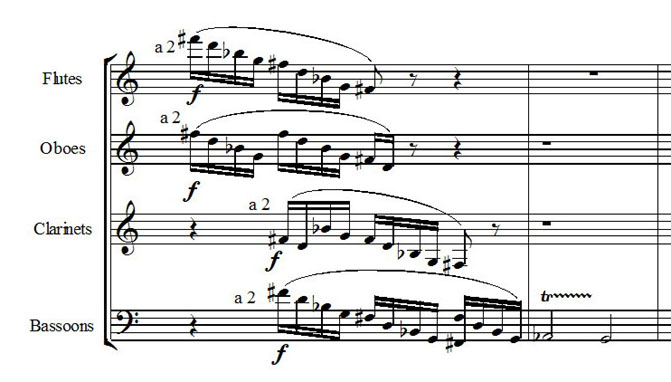
Breaking back. When the doubled passage in question covers a wide range,
it is common for a single instrument to break back an octave so as to
stay effective. Example:
All instruments except the flutes break back to
avoid too low a finish. The breaks should be staggered, to maintain a
continuous effect. Notice the first bassoon breaking one note before
the second. Can you suggest an improvement for this
example?
3.
Background Group
When strings or brass predominate, maybe the
woodwind will supply the backing. Possibilities are:
a) Holding
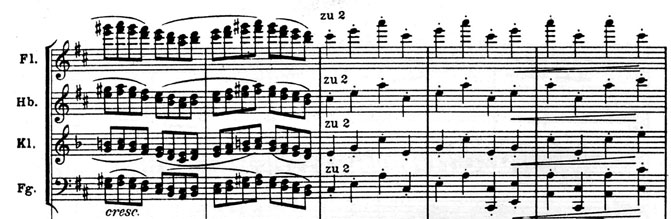
chords. This is the time to decide on
effective layouts: should we use
Overlapping
Superposition
Interlocking
Enclosing
This is just a simple
example; when the full section is employed you will have to make
several decisions, based on balance and blend. Interlocking gives the
best blend, though not necessarily the strongest power. Rules are
few; careful listening is all! With your virtual orchestra you can
hear the effect before you commit yourself, unlike the composers of the
past who had to imagine it all in their heads. (Aren't we
lucky?)
b) Repeated
notes, as for example the beginning of
Mendelssohn's Italian Symphony and the 2nd
movement of Beethoven's Eighth
Symphony.
c) Figuration. All woodwind are
adept at arpeggios, trills, 3rd-based tremolos, runs,
etc. However, the oboes may find it difficult to efface themselves
in this function (better at long holding notes); flutes and
clarinets are best.
(NS Chinese Dance,
19)
d)
Countermelodies. Refer to the advice
under Principal Section, above.
4.
Doubling Group
Woodwind often double the
material of the other groups, in tuttis. Generally, flutes and oboes
will double the violins, perhaps some of them an octave higher,
clarinets could double the horns or violas, bassoons will double the
cellos and basses. (NS Russian Dance, 1-16). This is
only one way; a lot depends on what the brass are doing. In a
fortissimo tutti, the brass will dominate, and one function of the
woodwind is to reinforce them, either at pitch or preferably in
higher octaves. If the full force of each woodwind is needed, then
flutes must be quite high, in their top octave, oboes and clarinets
above the stave, if not too high, (actually clarinets can be higher
than oboes) and bassoons low, with at least one of them in the
lowest octave. Alternatively the oboes could be on the stave,
medium or low, where they are strongest. (NS Flower Waltz,
266-273)
5. Mixed
functions
Of course there is nothing to
stop the woodwind sharing all or some of the above functions between
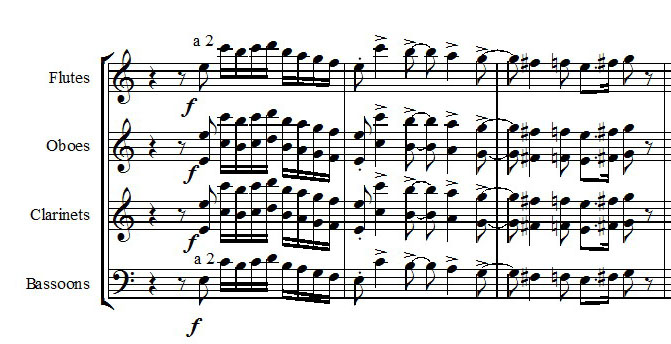
them.
Here the violins have the principal melody, the flutes
and oboes have a countermelody; clarinet 1 doubles a third melody in
the cellos, clarinet 2 doubles the viola part, and the bassoons
double the horn and double basses. The 'a 2' bug will cause no
trouble in the flutes and oboes, what with the octave doubling and
all else that is going on.
(Also NS Flower
Waltz, 133: Ob/Fl 8ve melody, Cl/Bsn interlocking
harmony)
6. Resting
function!
When writing for woodwind,
remember you don't have to use all of them: anything from one to
eight may occur according to circumstances. The fewer woodwind play,
the more focussed their contribution. It is interesting that in
The Marriage of Figaro Mozart uses the full eight woodwind in
only 3 out of 30 vocal numbers, restricting the woodwind to various
combinations from piece to piece. He reserves full orchestra for the
overture and big finales.
Refer to the seating chart above,
and you will see that the usual additions to the woodwind section are
piccolo, English horn, bass clarinet and contrabassoon. If all
these are added to the standard eight, the group is known as triple
woodwind. Larger orchestras may have quadruple woodwind, i.e. three of
each standard plus the four extras. These set-ups can be found in many
standard scores, wholly or partly. Twentieth-century scores will
probably use all four extras, nineteenth-century mostly make do with one
or two. It's handy to realise that the order of usefulness is also the
score order: piccolo being the most useful, English horn next, and so
on. This for two reasons: the higher the instrument the smaller and thus
cheaper; and the higher, the more useful for solos and general use. I
advise you to think of piccolo and English horn as pretty normal members
of the woodwind, with bass clarinet and contrabassoon used only if you
feel the music definitely calls for them.
Piccolo
This miniature flute, sounding
an octave higher than written, is possessed by the majority of
flautists: the similarity of tone production and fingering making it easy to
switch between the two instruments at the drop of a hat; indeed the switch can
be made with only a couple of bars' rest if need be. It is common even
in a 'double woodwind' set-up (the eight players) for the second
flautist to change to piccolo as required. Another common set-up is
three players: two flutes and a piccolo, or three flutes with third
player doubling on piccolo.
Like the flute, the instrument is
weak at the bottom and powerful (extremely!) at the top. Although it can
play solo, this is comparatively rare, and its main use is to provide
the top voice of the flute section, or to double somebody an octave
higher. (NS Chinese Dance, 11 onwards.) It makes a great
sparkle at the top of tuttis, but can become shrill and wearisome if
used too much, especially in its highest register.
English Horn
(= cor anglais) An alto
oboe, sounding a perfect fifth lower than written. Can be played by
second oboist or by an extra player.
Its haunting, nostalgic sound is
extremely effective in solo work, and it would be a pity to include it
in a piece if it never got a solo. (NS Mirlitons, 19) The
lowest register is the most characteristic, the upper notes being less
effective. Its other main use is to complete three-part harmony with the
oboes, or to replace the oboes' bottom notes with its smoother tone. It
blends well with the violas to give the effect of hopeless longing:
Tchaikovsky uses this combination to marvellous effect in his overture
Romeo and Juliet; Rachmaninov, in Piano Concerto No.2 in C
minor , doesn't include English horn in his orchestra, so tried
for the same effect by doubling violas with the oboe (which even has
to leave out its bottom notes rather than risk coarseness!) Cor anglais
would have been much better.
(See also NS Arabian
Dance, 5, where EH is enclosed between two clarinets. The composer could
have used bass clarinet for perfect blend, but clearly wanted the
'exotic' flavour of the EH. Enclosing it gives a partial blend. At bar
33 he does the same trick with two bassoons.)
Bass clarinet
Normally pitched in Bb, with
similar range to Bb clarinet but an octave lower. Part is written in the
treble clef, sounding a ninth lower than written. Usually an extra
player is required for this instrument, as two normal clarinets always
seem to be indispensable.
Again, the eerie bottom register is
the best, the upper register sounding rather characterless (use the
higher notes only in ensembles). It is excellent as a bass for the
woodwind group, or doubling the bass part in any orchestral situation.
Solos can be effective (NS Sugar-plum,
8).
Contrabassoon
Sounds an octave lower than
written, and normally played by an extra player.
It is no use pretending it is a
solo instrument, apart from grotesqueries like L'apprenti
Sorcier. It makes an excellent bottom layer either to a full
woodwind section or to tuttis. It will often double the string double
basses in unison.
'Luxury' woodwind
We may also have available the
following:
Alto flute. Not used a
great deal. Has a lovely sound, (fourth lower than written), and can
be thought of as similar to the English horn in that it stretches the
flute ensemble downwards.
Bass flute. Even rarer.
Sounds an octave lower than written. You'll seldom need it, apart from
special effects.
Oboe d'amore. Sounding a
minor 3rd lower than written, so midway in character
between oboe and English horn. Used by Bach, also a few
early-20th century composers.
Contrabass clarinet.
Sounds two octaves and a tone lower than written. Best in large
ensembles or military bands. Little used in symphonic
music.
E flat clarinet. Sounds a
minor 3rd higher than written. Rather more practical: agile
and clear in its upper register, so making a useful addition where
high clarinet notes are wanted. Can be over-shrill at the very top.
See finale of Berlioz's Fantastic Symphony.
Don't count on getting any of
these in an amateur orchestra, except possibly the E flat
clarinet.
1.
Breathing. Wind players
must breathe! Make sure phrases are not too long for this; in any case
the listener's ear must 'breathe'; we eat in mouthfuls and we like
listening in digestible chunks. The ability of computer music to play
without pause can be very misleading.
The oboes are a special case: the tiny aperture between the
double reeds means that very little wind can pass through at a time,
though it is under great pressure. This means that an oboist can play a
very long phrase (more than the others) but will be exhausted at the end
of it. Even with a normal phrase, he has not expelled all the air in his
lungs; this means that oboists need rests in order to exhale
stale air. Give oboes frequent rests for that
reason.
Large instruments like the contrabassoon and bass flute also
need compassion for the opposite reason that they require more breath to
play, compared with others.
Finally, give the complete woodwind section a rest from
time to time: let us hear the strings on their own,
perhaps.
2.
Articulation. You should be using a mixture of the three main types: a)
If you write a succession of notes without further marking, they will be
played non legato, achieved by tonguing every note (equivalent to
separate bows in the strings). b) Place a slur over the top, and the
legato effect is achieved by tonguing only the first note, allowing an
uninterrupted airflow for the rest of the slur. c) Dots over the notes
will produce the usual staccato. All woodwind can play staccato,
including a whole string of consecutive staccato notes, but not all with
the same facility or speed. Generally speaking, the larger the
instrument, the harder to play many staccato notes in succession. The
flute and oboe have no trouble at all, and a good clarinettist can
handle it; even so it is much more in the inherent nature of the
clarinet to play legato (slurred) than staccato, which takes a little
more effort. Just bear this in mind. (NS March 41, where the
clarinet part is simplified, also bar 61 on, both bassoon parts
producing the required effect between them.)
3.
Make it interesting. For everybody, not just the soloists. We normally give solos
to player 1 of each pair, but make sure player 2 has some fun also. When
an important but simple melody is doubled in octaves between two or more
players, why not give this to the 2nd player of each pair?
You will earn their gratitude and they will play all the
better.
4.
Nutcracker Suite. Over and above all the examples I have quoted from this work,
you would be well advised to sit studying the woodwind writing
throughout the entire work, asking yourself at every turn 'Why has he
done that?' When you can score as well as Tchaikovsky you will be a
proud person!
5.
Further study.
After that, study Rimsky-Korsakov,
Brahms, Debussy, Ravel, Stravinsky, Kodaly, Elgar, Britten, Walton, oh,
everybody! Good orchestration books abound: I recommend Blatter's
Instrumentation and Orchestration as a start, particularly if you
are writing for an amateur orchestra, then Piston's Orchestration
for more detailed information on the properties of the various
instruments.
6.
Useful
websites.
Terry
Dwyer
November
2004